
Q4 Is Won in September: The 3 Things Brands Must Lock In Before October 10

THE CLOCK IS TICKING!
The holiday rush rewards the brands that make practical decisions before the rush begins.
Black Friday is not won on Black Friday.
For growing eCommerce brands, the outcome is usually shaped by decisions made weeks earlier, when order volume still looks manageable and the warehouse still has room to adjust. By October 10, many of the most important choices should already be made.
That date is not a legal deadline or a universal rule. It is a practical planning cutoff for many brands because inbound capacity starts tightening, receiving queues lengthen, and late-arriving inventory may not be available when customers are ready to buy.
If you are planning Q4 now, focus on three operational priorities:
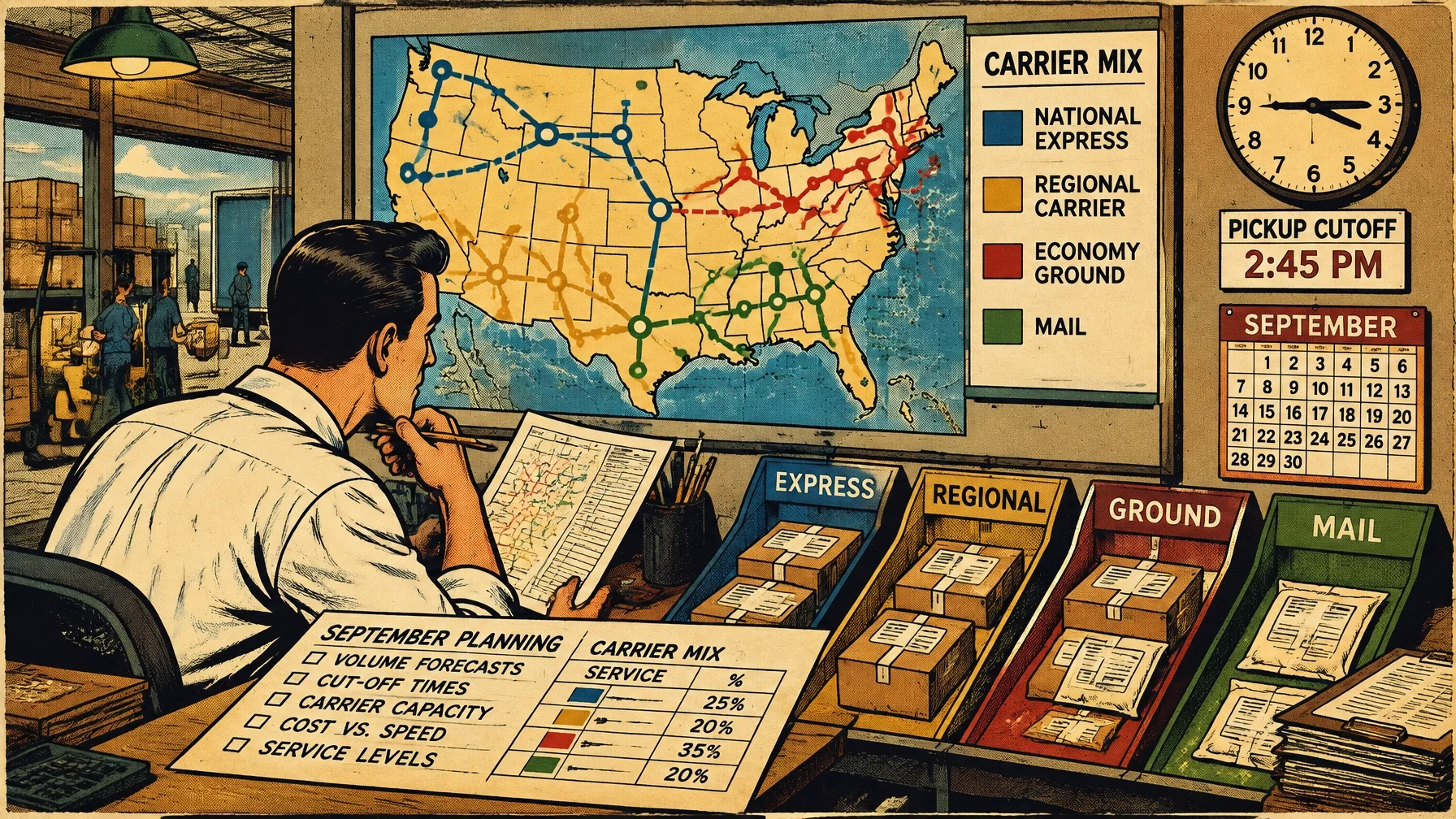
Lock in your carrier mix and pickup cutoffs.
Pre-position core inventory by October 10.
Fix your true cost-to-serve before peak volume arrives.
1. Lock in your carrier mix and cutoff dates in September
Carrier strategy is more than choosing the lowest published rate.
Your real Q4 shipping cost depends on:
Package dimensions and weight
Destination zones
Residential delivery volume
Delivery speed
Oversize and additional handling exposure
Pickup schedules
Peak and demand surcharges
Your ability to shift volume between carriers
FedEx and UPS demand surcharge programs are now appearing earlier in the season. FedEx’s current 2026 schedule includes demand fees beginning in September for certain non-standard shipments, with residential charges beginning in October. Its enterprise residential demand charge is also calculated dynamically by week, with a lag between the calculation period and the application period.
UPS uses its own surcharge structure and volume logic, but the planning lesson is similar: Q4 transportation costs are not fixed for the entire season. They can change based on the week, your volume, and the type of shipment.
Review the carrier announcements directly, including the current FedEx demand surcharge schedule, before finalizing your holiday shipping plan.
Why November is too late to make this decision
If you wait until November to decide which carrier should handle your orders, you are not making a strategy decision. You are reacting to capacity, fees, and service constraints that are already in effect.
A late carrier change can require:
New shipping rules in your warehouse management system
Updated label settings
Revised delivery promises on your website
New pickup appointments
Additional packaging tests
Customer service training
A new process for exceptions and lost packages
Some industry reporting has estimated that late-Q4 shipping decisions can cost approximately 15% to 25% more per parcel. That range is not a universal guarantee, but it illustrates the cost of losing flexibility when peak demand is already underway.
Set your carrier logic in September. For example:
Use one carrier for standard residential parcels in lower zones.
Use another for heavier products where negotiated rates are stronger.
Route oversized or irregular packages through a service that limits additional handling exposure.
Maintain a tested backup option for key regions.
Establish daily pickup cutoffs that your warehouse can consistently meet.
Shopify merchants may already have access to meaningful UPS discounts through Shopify Shipping. Shopify has promoted negotiated UPS rates for merchants of all sizes, including discounts that were once more closely associated with enterprise accounts. Some recent industry coverage has described this arrangement as expanded, although the publicly available Shopify material most clearly confirms the ongoing negotiated-rate benefit.
That is useful. It is not the entire 3PL decision.
Better carrier rates alone do not solve:
Receiving delays
Inventory inaccuracies
Packaging problems
Kitting requirements
Returns
Customer escalations
Promotional projects
Lack of operational visibility
The best 3PL for eCommerce brands helps you combine carrier pricing with warehouse execution, packaging decisions, inventory placement, and customer experience.
2. Pre-position core inventory by October 10
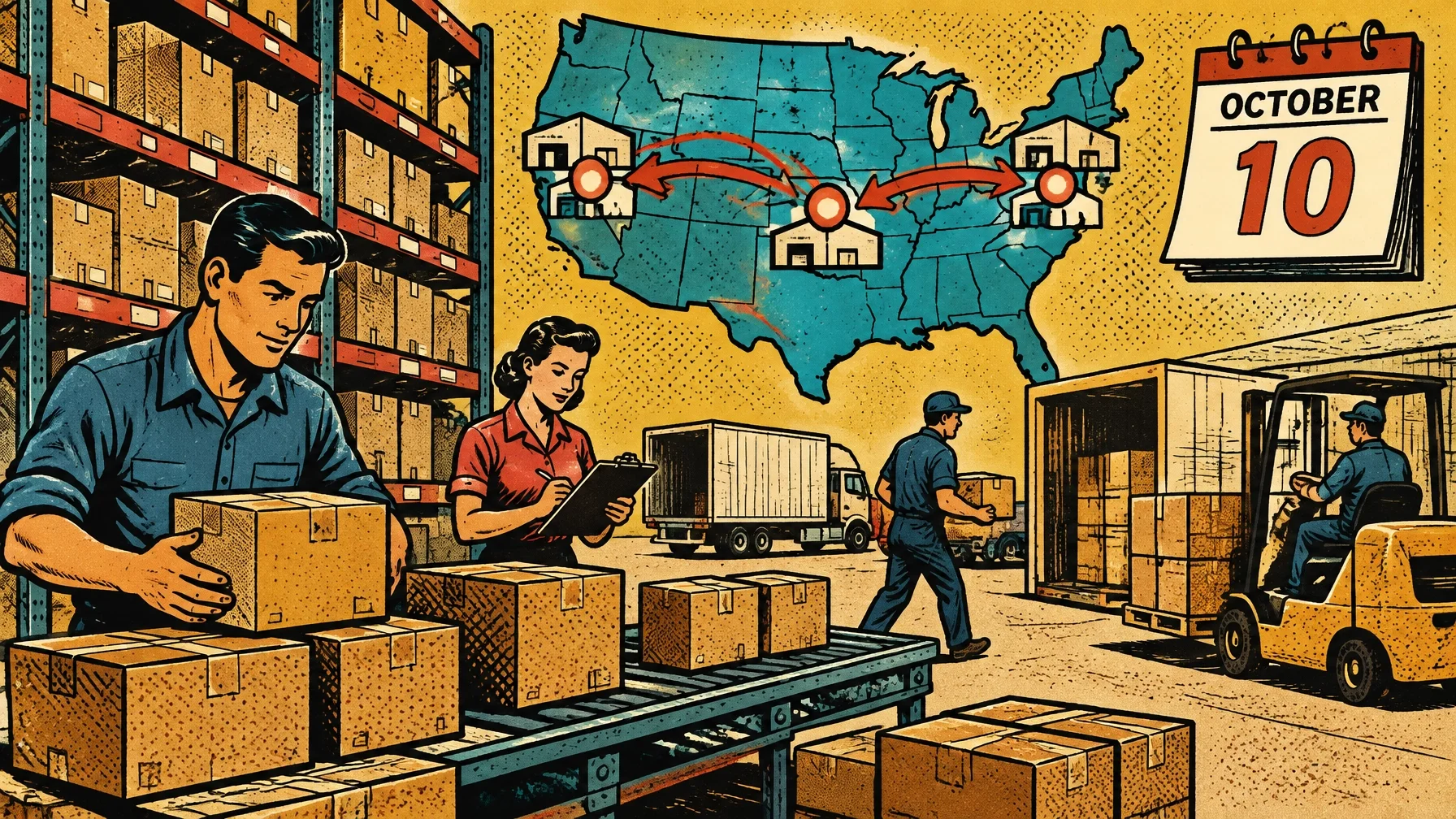
Distributed inventory networks can reduce shipping zones and help protect delivery promises.
If all your inventory sits in one location, an order traveling across the country may require more transportation time and cost than the same order shipped from a region closer to the customer. Placing inventory in multiple domestic locations can shorten average delivery distance and reduce pressure on one warehouse.
That does not mean every brand needs five fulfillment centers. It means you should evaluate where your customers are located and whether your core products should be closer to them before peak demand arrives.
PICK YOUR CARRIERS BEFORE PEAK PICKS YOU!
Closer inventory gives your Q4 fulfillment plan more room to breathe.
What should be pre-positioned?
Start with the products that are most likely to drive holiday orders:
Best-selling evergreen SKUs
Promotional bundles
Giftable products
Seasonal items
Products with long replenishment lead times
Products that are expensive to ship across multiple zones
Do not automatically distribute slow-moving or highly complex inventory. Placement decisions should account for sales velocity, storage requirements, replenishment time, and the cost of moving stock between facilities.
Current freight outlooks are also projecting September import volumes to be among the highest of the year. That creates a narrow operating window. Inventory arriving with enough time for receiving, counting, putaway, and system updates can support holiday sales. Inventory arriving late may sit in a receiving queue during the weeks when it needed to be available.
Why October 10 is a useful planning cutoff
October 10 gives many brands time to:
Complete inbound receiving before the heaviest holiday volume
Resolve inventory discrepancies
Finish kitting and bundling
Test order routing
Replenish the fastest-moving locations
Confirm packaging materials are available
Adjust forecasts before Black Friday promotions begin
It also gives your fulfillment partner time to identify problems while there is still time to correct them.
Recent changes to EU de minimis treatment have added another reason for brands to review inventory placement. Depending on the product, origin, destination, and applicable rules, cross-border parcels may face more cost or customs complexity than they did previously. Pre-positioning inventory in the destination market can be one response, but it is not automatically the right answer for every business. Review the economics and regulatory requirements with your customs or logistics advisors.
The important point is simple: do not treat inventory as available until it has been received, counted, stored, and released for sale.
3. Fix cost-to-serve before peak, not after
Revenue growth can hide an unprofitable fulfillment model.
A product may look profitable based on its wholesale cost and selling price. But the actual cost of serving that order may include:
Picking labor
Packing labor
Packaging materials
Storage cube
Shipping by zone
Dimensional weight
Returns
Reshipments
Address corrections
Order exceptions
Kitting
Gift wrapping
Special handling
Customer service time
Industry reporting from FreightWaves, based on Commerce Signal data, described fulfillment operator margin cushions falling from approximately 9.7 percentage points to 0.6 points in one quarter. Those figures describe a specific dataset and segment, not every 3PL or eCommerce brand. Results vary by company, pricing model, product mix, and methodology.
The broader lesson still applies: parcel-heavy fulfillment economics can change quickly.
If your cost-to-serve is already unclear, Q4 volume will not make the problem easier to find. It will make the problem larger.
STOCK CLOSER. SHIP FASTER!
Peak volume magnifies small cost problems. Measure them while there is still time to adjust.
Build a true per-order view
Review your highest-volume SKUs and order profiles before finalizing promotions.
Calculate the approximate cost of:
A single-item order
A multi-item order
A bundled order
A gift-wrapped order
An order requiring custom packaging
An order shipped to a distant zone
A returned order
An order that needs replacement or reshipment
Then compare those costs with your planned prices, discounts, and free-shipping thresholds.
You may find that:
A smaller mailer reduces both material and dimensional costs.
A bundle is profitable only when items are pre-kitted.
A free-shipping threshold needs to increase for heavy products.
A slow-moving product is consuming more storage than expected.
A high-return product needs better packaging or product information.
A special project should be completed before peak labor becomes expensive.
This is also where packaging deserves attention. Industry coverage has highlighted warehouse automation, including reports of Guess deploying 127 Exotec Skypod robots, as well as efforts to replace single-use film with reusable plastic containers in some operations. Those examples show where the industry is heading, but you do not need a large robotic system to improve your own economics.
Start with practical changes:
Reduce unnecessary package dimensions.
Standardize packaging where it makes sense.
Use right-sized materials.
Pre-assemble repeatable kits.
Separate exception work from normal pick-and-pack.
Track returns by SKU and reason.
Review storage cube instead of counting units alone.
The best cost-to-serve analysis is specific enough to change a decision.
What the wider fulfillment market is telling brands
The market is giving growing brands more choices, but each option has tradeoffs.
Industry coverage has reported that Flexport may reduce or exit parts of its U.S. warehouse footprint. Amazon MCF is reportedly courting DTC brands in the approximately $5 million to $50 million revenue range with storage credits and closer Shopify integration. Amazon has also reportedly been scaling Project Mercury toward more than 1,000 same-day facilities.
These developments may create useful alternatives. They do not eliminate the need for operational judgment.
Amazon MCF can offer speed and network density, but some brands may have less control over branded packaging, custom inserts, gift wrapping, or channel-specific workflows. An independent 3PL may offer more flexibility and brand-level care, but you should still evaluate its geographic coverage, systems, labor model, and peak capacity.
Ask every potential partner:
Where will my inventory be stored?
How are orders routed?
What happens during a volume spike?
Can you support custom packaging and kitting?
How quickly is inbound inventory processed?
How are exceptions communicated?
What does my true cost per order include?
Who will manage my account?
Your September action plan
Before October 10, complete these five steps:
Approve your carrier mix. Document which carrier handles each major product and destination profile.
Publish internal cutoff dates. Include inventory arrival, receiving, kitting, packaging, and promotional launch dates.
Place core inventory closer to demand. Use sales data, customer geography, and replenishment lead times.
Calculate cost-to-serve. Review pick density, pack complexity, storage cube, exceptions, returns, and special handling.
Confirm your 3PL’s operating plan. Make sure capacity, labor, systems, packaging, and communication expectations are clear.
The practical advantage of a boutique 3PL
Rogue Fulfillment supports growing brands with a more personal operating model. The company states a 99.84% order accuracy rate and that 99% of orders ship within 24 hours. These are Rogue-stated metrics, not universal guarantees, and actual performance depends on the account, product, volume, and agreed processes.
Rogue also offers:
A dedicated account manager instead of a ticket queue
Same-day inventory processing
24/7 access to real-time data
Kitting and gift wrapping
Custom packaging
Marketing campaign support
Project management and special handling
Free access to The Rogue Cooperative
Those services matter because Q4 fulfillment is rarely limited to pick, pack, and ship. You may need a partner to coordinate a product launch, assemble a gift set, manage a packaging change, or help you understand why a promotion is less profitable than expected.
Q4 is won in September because September still gives you choices.
You can adjust carriers before surcharges compound. You can place inventory before receiving queues tighten. You can fix cost-to-serve before volume makes every weakness more expensive.
If you want a second set of eyes on your carrier plan, inventory placement, and peak economics, talk to Rogue Fulfillment about a free peak readiness review.