
Rate Shopping: The Quiet Habit That Protects Your eCommerce Margins

COMPARE THE ROUTES. PROTECT THE MARGIN.
Shipping is one of those costs that can quietly change the economics of an order.
A product may be profitable when you review its wholesale cost, selling price, and fulfillment labor. Then carrier surcharges rise, a package crosses into a more expensive zone, or oversized packaging triggers dimensional weight charges. Suddenly, the margin you expected is smaller than planned.
That is why rate shopping matters.
Rate shopping is the process of comparing live carrier rates for each individual order and selecting the best qualifying option. The decision considers:
Destination zone
Package weight
Package dimensions
Service level
Transit time
Promised delivery date
Carrier coverage and reliability
Instead of sending every order through one default carrier, you use the carrier and service that make the most sense for that specific shipment.
For growing brands, this is not just a shipping tactic. It is a practical habit that supports healthier margins, better customer experiences, and more flexible operations.
What Is Rate Shopping?
True rate shopping compares available carrier services at the time an order is packed and ready to ship.
A shipping system may compare options from national carriers, postal services, and regional carriers. It then selects the lowest-cost service that still meets the delivery promise.
For example, a lightweight order going to a nearby zone may qualify for a postal service. A heavier package going across the country may be more economical through a ground carrier. A regional carrier may perform well on a particular lane, while another carrier may offer better coverage for rural ZIP codes.
The best option changes according to the shipment.
Static Carrier Rules Versus True Per-Order Rate Shopping
Static rules are based on general assumptions. They may look like:
Use Carrier A for all domestic orders
Use Carrier B for packages under two pounds
Use a flat shipping rate for every customer
Use ground service unless the customer pays for an upgrade
These rules can be useful starting points, but they do not evaluate the actual cost and delivery requirements of each order.
True per-order rate shopping is more precise. It looks at the order’s destination, weight, dimensions, service level, cutoff time, and delivery promise before assigning a carrier.
That distinction matters because carrier pricing is not fixed across every shipment profile.
Why Rate Shopping Matters for Growing eCommerce Brands
1. It protects your margin as shipping costs change
Carrier pricing changes over time. General rate increases, fuel charges, residential fees, peak-season surcharges, and package handling fees can all affect your cost per order.
If you use one carrier by default, you may continue paying the same way even when another option becomes more economical.
Rate shopping gives you a way to respond to those changes. You can compare current rates instead of relying on an outdated spreadsheet or a shipping rule that made sense last year.
The savings may be small on one package. Across hundreds or thousands of orders, small differences can have a meaningful effect on profitability.
2. It reduces dependence on one carrier
A single-carrier strategy creates exposure.
If that carrier raises prices, changes service standards, experiences network congestion, or has a disruption in a region where you sell heavily, your brand has fewer alternatives.
Multi-carrier fulfillment gives you more flexibility. Volume can move toward the carrier that offers the best combination of price, coverage, and performance for the shipment.
This does not mean changing carriers constantly. It means having enough options to make informed decisions.
3. It helps you keep delivery promises
The cheapest service is not always the right service.
A low rate does not help if the package arrives late, has poor tracking, or cannot reliably serve the destination. Rate shopping should match the cost decision with the delivery promise you made to the customer.
That may mean choosing:
Economy service for a flexible delivery window
Ground service for a standard promise
Expedited service when timing is essential
A regional carrier for a strong local lane
A national carrier when broader coverage is more dependable
Shipping cost is a top driver of cart abandonment, but customers also pay attention to delivery timing and clarity. A lower price at checkout is not useful if the delivery estimate is vague or inaccurate.
How Rate Shopping Works in Practice
A reliable rate-shopping process uses more than a list of carrier accounts.
Start with destination zones
Carriers divide the country into shipping zones based on the distance between the origin and destination.
The same product can cost very different amounts to ship depending on where it is going. A brand may find that one carrier is strong in nearby zones while another is more competitive for distant shipments.
Your rules should account for these differences.
Use accurate weight and dimensions

MEASURE FIRST. SHIP SMARTER.
Carriers may price a package using actual weight or dimensional weight, depending on which produces the higher billable weight.
Dimensional weight is especially important for products that are light but occupy a large box. If your product data or box measurements are inaccurate, your rate-shopping results will be inaccurate too.
Maintain reliable information for:
Product weight
Product dimensions
Box dimensions
Packaging materials
Multi-item orders
Items that must ship separately
Packaging choices also matter. A right-sized box can reduce unused space and help prevent unnecessary dimensional weight charges. Rogue’s guide to sustainable right-sized packaging for eCommerce covers how packaging decisions affect both customer experience and fulfillment efficiency.
Match the service level to the promise
Your system should not select the cheapest possible service without checking the delivery requirement.
Instead, define the acceptable service level first. Then compare carriers that can meet it.
For instance, a customer who selected standard delivery should receive a service that fits the standard delivery window. An expedited order should not be assigned to an option that looks inexpensive but cannot meet the promised date.
Include regional carriers and backup accounts
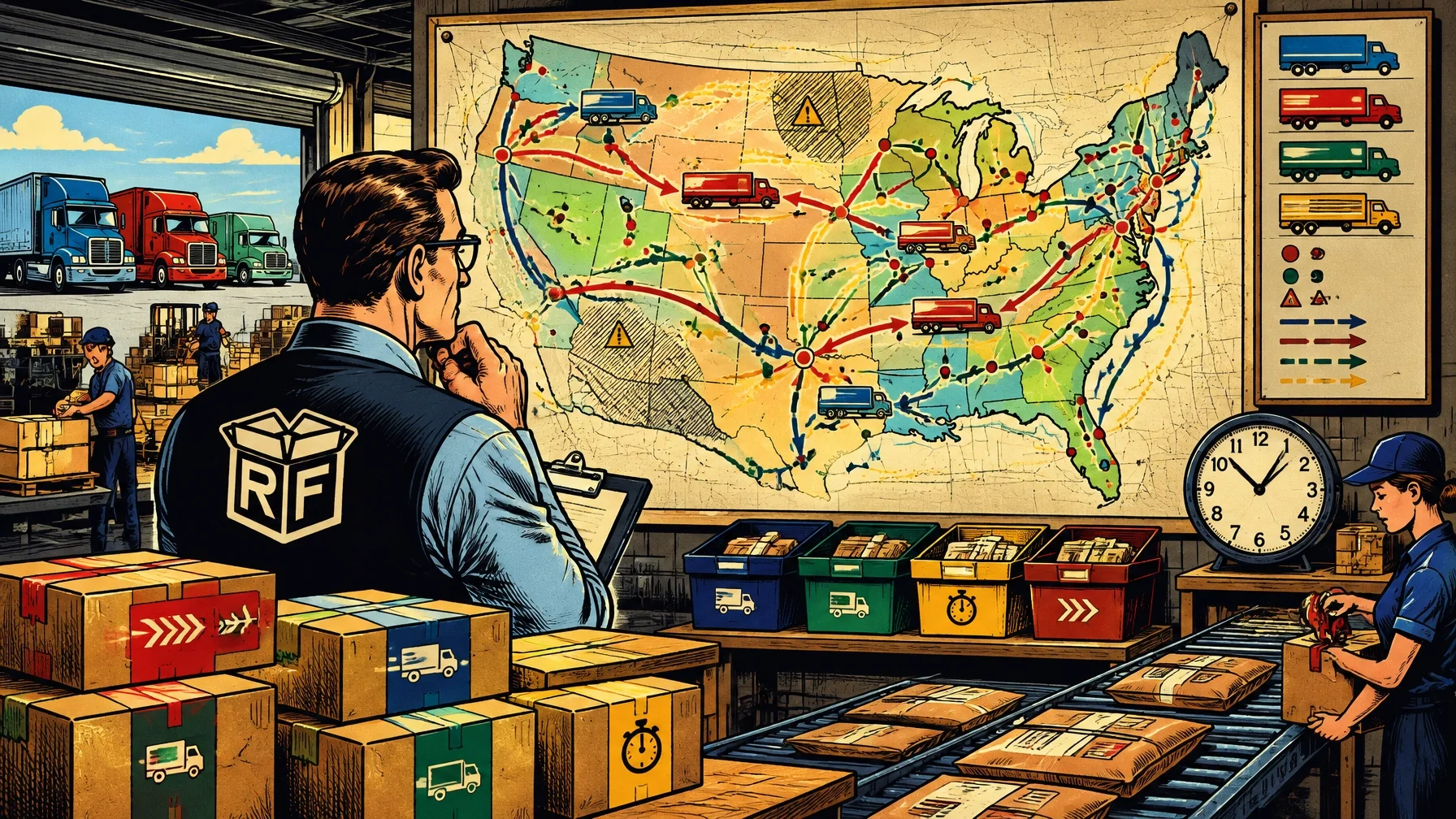
KEEP A BACKUP ROUTE READY.
Regional carriers can be useful for specific lanes, but they often have coverage gaps. Rural ZIP codes, remote destinations, and certain residential routes may require a national carrier or postal option.
That is why a backup plan matters.
A strong multi-carrier setup may include:
National carrier accounts
Postal shipping options
Regional carrier accounts
Backup services for coverage gaps
Rules for rural and remote destinations
Manual review for unusual or high-value shipments
Account for cutoff times
A rate is only useful if the order can leave on time.
Your fulfillment rules should consider daily carrier pickup times, warehouse processing time, and the time an order enters the system. If an order misses the cutoff, the expected delivery date may change even when the original service level remains the same.
During peak volume, order management rules also help prevent assignment errors. Test that the system can handle inventory availability, service restrictions, carrier outages, and high order volume without defaulting to the wrong service.
Signs Your Brand May Be Overpaying
Your shipping process may be under-optimized if:
One carrier handles nearly all your orders without regular review
You cannot see shipping cost by order, SKU, zone, or service level
Your free shipping threshold was set without current rate data
Your packaging creates unnecessary dimensional weight charges
You do not compare delivery performance against shipping cost
Your checkout options do not reflect your actual fulfillment capabilities
You have no plan for peak-season surcharges
Your team makes carrier decisions manually during busy periods
You cannot explain why one carrier is being selected over another
These signs do not necessarily mean your current carrier is wrong. They indicate that your process may not be using enough data to make the decision.
A Practical Rate-Shopping Action Plan
You do not need to redesign your entire fulfillment operation in one week. Start with a focused review.
Pull 90 days of order data. Include destination ZIP codes, zones, weights, dimensions, service levels, shipping costs, and delivery results.
Segment the orders. Group them by destination zone, weight break, package size, product type, and delivery promise.
Re-rate each segment across at least three carrier options. Compare the actual cost for services that meet the required delivery window.
Compare cost against performance. The lowest rate is not the best choice if it creates late deliveries or poor tracking.
Set zone-based rules. Define which carriers and services are eligible for different shipment profiles.
Test the logic before peak. Run sample orders through the system, including rural addresses, multi-item orders, oversized packages, expedited shipments, and missed cutoff scenarios.
Review the rules quarterly. Carrier pricing, surcharges, packaging, order mix, and customer expectations all change.
How a 3PL for eCommerce Brands Can Help
Rate shopping works best when it is connected to accurate inventory, reliable packaging data, and a fulfillment team that can manage the process consistently.
That is one reason growing brands often choose a 3PL for eCommerce brands instead of managing every shipping decision alone.
At Rogue Fulfillment, multi-carrier flexibility is part of a broader operating approach. Brands also receive full transparency with 24/7 access to real-time data, a dedicated account manager instead of a ticket queue, and same-day inventory processing.
The operational details matter, too. Value-added services such as kitting, gift wrapping, custom packaging, and campaign support are available as standard parts of the partnership rather than isolated extras.
Rogue reports a company-stated 99.84% order accuracy rate and says 99% of orders ship within 24 hours. These are company-stated figures, not guarantees, but they reflect the importance of connecting rate decisions with dependable fulfillment execution.
Brands also receive free access to The Rogue Cooperative network, which provides opportunities for business growth and peer support.

GOOD DATA MAKES BETTER SHIPPING DECISIONS.
The Bottom Line
Rate shopping is a quiet operational habit with a direct effect on your margins.
It helps you compare live carrier options, reduce dependence on one shipping provider, control packaging-related costs, and make delivery promises that your fulfillment process can support.
The goal is not always to choose the cheapest rate. The goal is to choose the best qualified rate for each order.
Pull your recent shipping data, review your zones and weight breaks, compare multiple carriers, and test your rules before the next peak season. If you want a second look at your current carrier mix, packaging, and shipping logic, talk to Rogue Fulfillment about a shipping and rate review. A practical review can show where your current process is working, where it is leaking margin, and which improvements are worth making next.