
Why Minneapolis/St. Paul a Sneaky-Good Fulfillment Hub
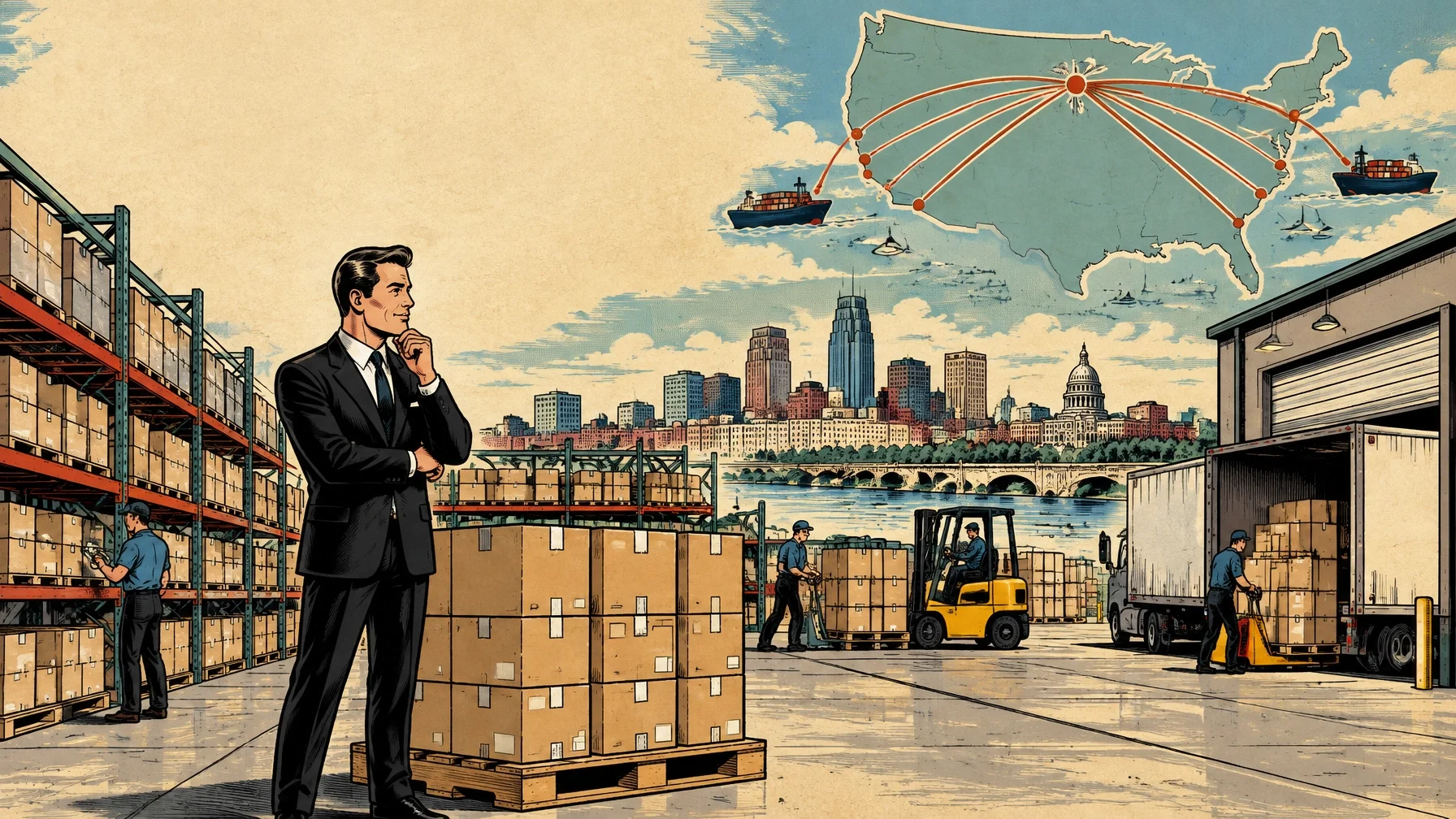
THE MIDWEST MOVES EVERYTHING!
Choosing a warehouse location can feel like a background decision. You compare storage rates, tour a facility, review the software, and move on to more visible questions.
But location quietly influences nearly every order you ship.
Where your inventory sits affects shipping zones, delivery estimates, carrier costs, peak-season reliability, and the amount you may need to spend on express upgrades. For a growing brand, those details can add up quickly.
That is why the Twin Cities deserves a closer look.
Minneapolis and St. Paul offer a central US location, strong freight infrastructure, access to national and regional carriers, and a well-established warehouse market. For many growing eCommerce brands, a Midwest fulfillment node can provide a practical balance between delivery speed, operating cost, and network simplicity.
Why Your Fulfillment Location Matters More Than You Think
Your fulfillment center is not just a place where products wait on shelves. It is the starting point for every parcel’s journey.
Shipping zones begin at the warehouse
Most parcel carriers use zone-based pricing. In simple terms, the farther a package travels from its origin, the more likely it is to fall into a higher shipping zone.
A brand shipping from a coastal warehouse may have efficient delivery into nearby states. However, orders traveling to the opposite coast or into the central US may cover much greater distances.
That can affect:
The base cost of each shipment
Delivery time by ground service
Access to lower-cost shipping methods
The viability of free shipping offers
The amount you pay for expedited upgrades
Your margin on orders going to distant customers
The issue is not that coastal warehouses are always inefficient. It is that the best location depends on where your customers are, not simply where your company started.
Delivery promises depend on realistic transit times
Customers want to know when an order will arrive before they complete checkout. If your delivery estimate is too slow, they may abandon the cart. If it is too optimistic, you may create customer service problems when the package arrives late.
A central warehouse can shorten the average ground distance to both coasts compared with a warehouse located on only one coast. That may give you more opportunities to use standard ground service while still offering a reasonable delivery window across a broad customer base.
A realistic delivery promise is usually more valuable than a low headline shipping rate that does not reflect the actual service your customer receives.
Peak season makes distance more important
During the holiday season, carrier networks operate under more pressure. Volume rises, capacity becomes more limited, and delays can be harder to absorb.
A shorter average route does not eliminate every risk. It can, however, reduce the number of long-distance handoffs and give your fulfillment partner more practical options when one carrier or lane becomes constrained.
Location is not a complete peak-season strategy. It is one of the foundations.
The Practical Case for a Midwest Fulfillment Node
The Twin Cities sit near major north-south and east-west transportation routes, including the I-35 and I-94 corridors. The region also has access to Minneapolis-Saint Paul International Airport, rail infrastructure, freight networks, and a broad warehouse market.
Regional distribution providers commonly point to the Twin Cities’ highway access and Upper Midwest reach as reasons the area works well as a logistics hub. You can learn more about the region’s freight positioning through this overview of the Minneapolis strategic distribution hub.
For an eCommerce brand, the practical advantages may include:
Shorter average ground distances than a single-coast warehouse
More opportunities to serve Midwest customers quickly
Greater access to ground shipping instead of costly express service
Fewer orders traveling through the highest zones
Better options for serving customers in both eastern and western markets
A strong base for testing a second fulfillment node later
The right conclusion is not that every brand should move to Minnesota. It is that the Twin Cities should be part of the network conversation.
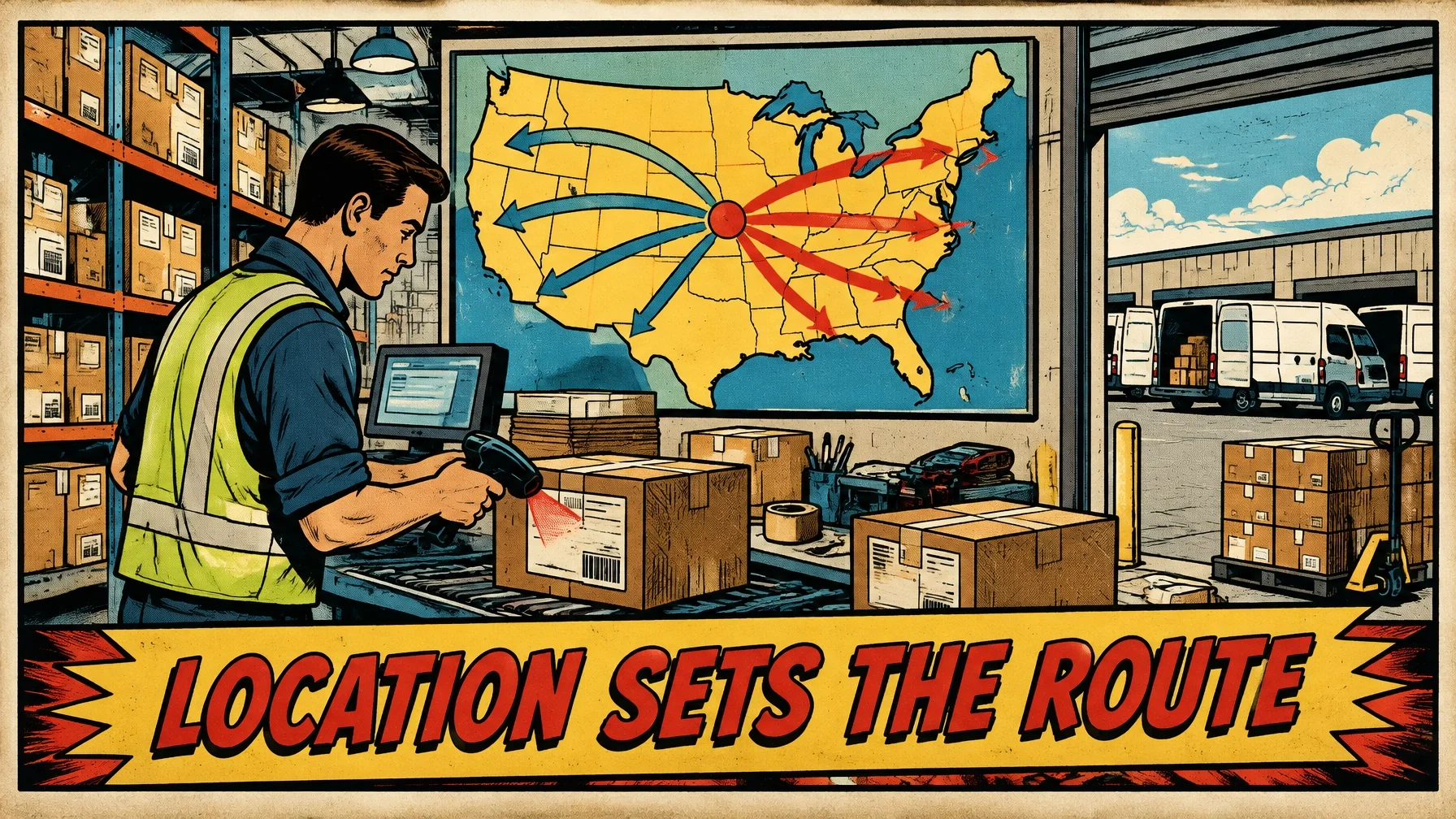
LOCATION SETS THE ROUTE!
When a Single Twin Cities Node Makes Sense
A single central node often works well when your customer base is spread across the country and your products are relatively easy to ship by parcel.
It may be especially useful if you:
Have outgrown home-based fulfillment
Ship primarily small or medium-sized packages
Want to keep inventory in one place
Need a simpler operation before adding more warehouses
Serve customers across multiple regions
Want to balance shipping speed with manageable operating costs
Keeping inventory in one location can also simplify purchasing, cycle counting, replenishment, forecasting, and quality control. You are not trying to keep several warehouses stocked with the same products before you have enough order volume to justify the complexity.
For many growing brands, operational simplicity is a benefit in itself.
When a Midwest Node Is Not the Whole Answer
A Twin Cities location is not automatically the best choice for every product or customer profile.
A coastal warehouse or multi-node network may make more sense when:
Your customers are concentrated in one region
If most of your orders come from Southern California, the Northeast, or another specific area, placing inventory near that customer concentration may reduce average transit distance.
The same principle applies to brands with a very regional product, such as merchandise tied to one local market.
Your products are oversized or freight-heavy
Large, heavy, or irregular products do not always follow the same economics as small parcel shipments. Freight class, dimensional weight, appointment delivery, and special handling can matter more than standard parcel zones.
In these cases, the best warehouse may be the one with the right dock setup, equipment, freight relationships, and storage configuration.
Your order volume supports distributed inventory
Adding a second or third node can reduce zones and improve delivery coverage. It can also add:
Inventory transfers between facilities
More complex forecasting
Split purchase orders
Higher minimum volume requirements
Additional receiving and storage costs
More complicated returns and reconciliation
Distributed inventory is a tool, not a default. Use it when the service improvement and cost savings justify the added coordination.
A thoughtful 3PL should be willing to tell you when one node is enough and when it is not.
Carrier Mix Matters Too
Warehouse location changes which carriers and lanes are competitive for your orders.
A good multi-carrier fulfillment strategy does not rely on one national carrier for every shipment. It considers the destination, package size, service level, delivery promise, and current rate structure.
Depending on your order profile, that may include:
National parcel carriers
Postal services
Regional parcel carriers
Local delivery providers
Freight carriers for larger shipments
A Twin Cities origin gives your 3PL access to a different mix of lanes than a warehouse on the West Coast or East Coast. The important question is not simply, “Which carrier do you use?”
Ask instead:
How do you compare carriers for each destination?
Do you re-rate shipments before labels are created?
Which regional carriers serve my customer base?
How do you handle rural, residential, and remote-area deliveries?
What happens when a carrier adds a surcharge or service restriction?
Multi-carrier fulfillment should help you make practical decisions order by order. It should not mean adding complexity without clear savings or service benefits.
Infrastructure, Labor, and Operating Costs
The Twin Cities also offer operational advantages beyond parcel distance.
The region has an established warehousing and logistics labor market, major highway connections, carrier hubs, rail access, and air freight infrastructure. Those factors support both inbound inventory movement and outbound order fulfillment.
Operating costs can also be more manageable than in some major coastal metros. Lower facility and labor costs do not guarantee lower total fulfillment costs, but they may give a growing brand more room to invest in service, packaging, technology, and inventory.
That balance matters. The cheapest warehouse is not always the most efficient warehouse. A facility with reliable staffing, strong processes, and accessible transportation may create more value than a low rate paired with slow receiving or inconsistent order handling.
How to Evaluate a 3PL’s Location
Do not choose a 3PL based on a map alone. Ask the provider to connect its location to your actual order data.
A useful location review should include:
A zone and transit analysis
Provide recent order data and ask how shipments would distribute by zone and delivery window from the proposed warehouse.Cost by destination and package profile
Compare shipping costs by zone, weight, dimensions, residential status, and service level.Carrier options for your customers
Ask which national and regional carriers serve your destination mix and how rates are compared.Peak capacity planning
Find out how the 3PL prepares for holiday volume, carrier constraints, staffing needs, and receiving surges.A plan for regional concentration
If many of your customers live in one region, ask how the provider would address that concentration. The answer may be a different node, zone skipping, a regional carrier, or simply a well-managed single-node strategy.
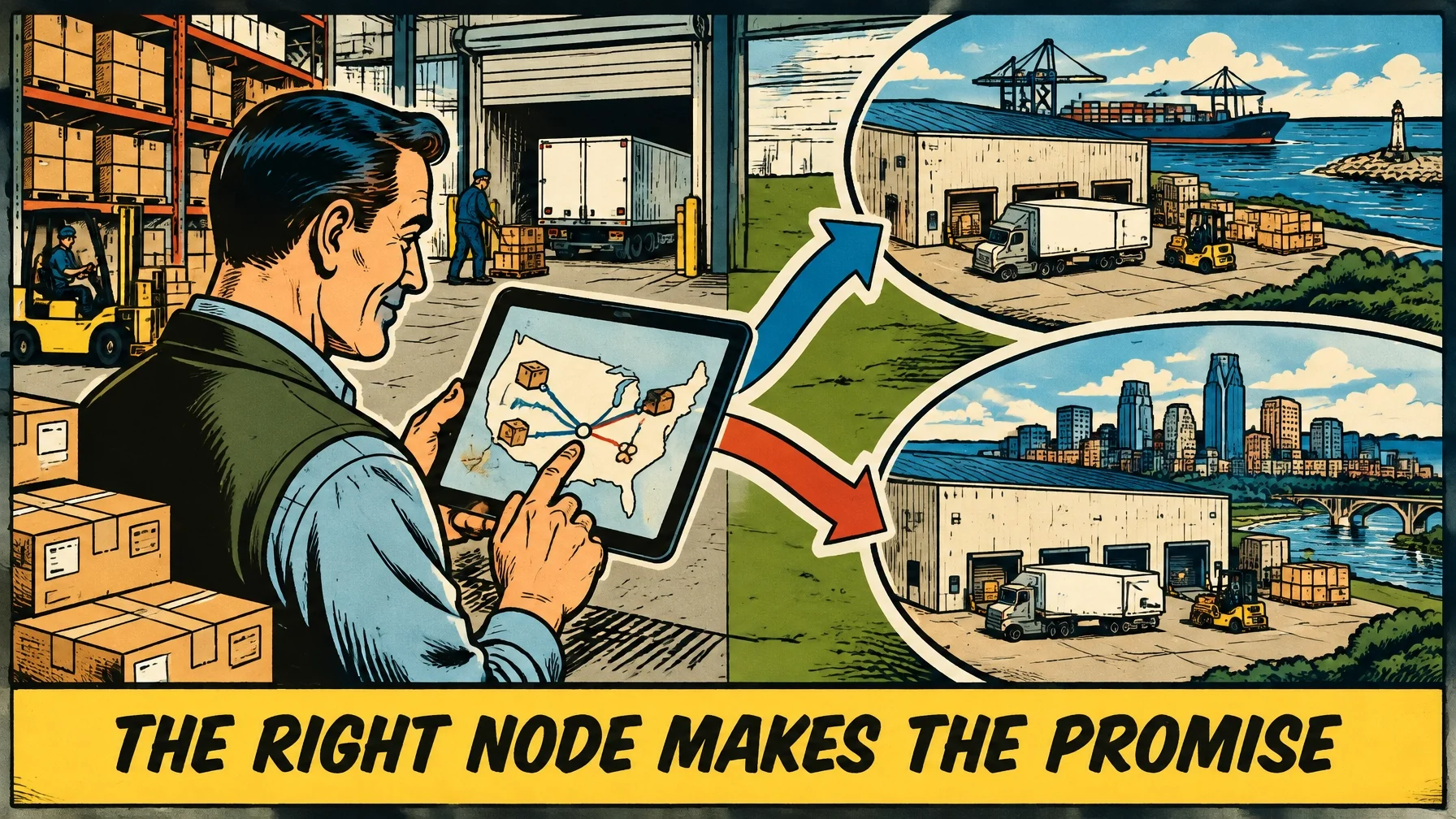
THE RIGHT NODE MAKES THE PROMISE!
What This Looks Like at Rogue Fulfillment
Rogue Fulfillment is a boutique 3PL for eCommerce brands based in St. Paul. The Twin Cities location is part of what Rogue offers, but it is not the entire value proposition.
The goal is to pair a practical Midwest fulfillment location with the personal attention growing brands often lose at larger providers.
That includes:
A dedicated account manager instead of a ticket queue
Same-day inventory processing
24/7 access to real-time data
Multi-carrier flexibility and rate shopping
Kitting, gift wrapping, custom packaging, and campaign support as standard value-added services
Support for platforms such as Shopify, Amazon, WooCommerce, Squarespace, and Etsy
Free access to The Rogue Cooperative, a network built for business growth and peer support
Rogue reports a company-stated order accuracy rate of 99.84% and says 99% of orders ship within 24 hours. These are company-stated figures, not guarantees for every future order or product profile.
For more context, you can explore Rogue’s perspective on choosing a 3PL for eCommerce brands or learn about boutique 3PL support for growing brands.
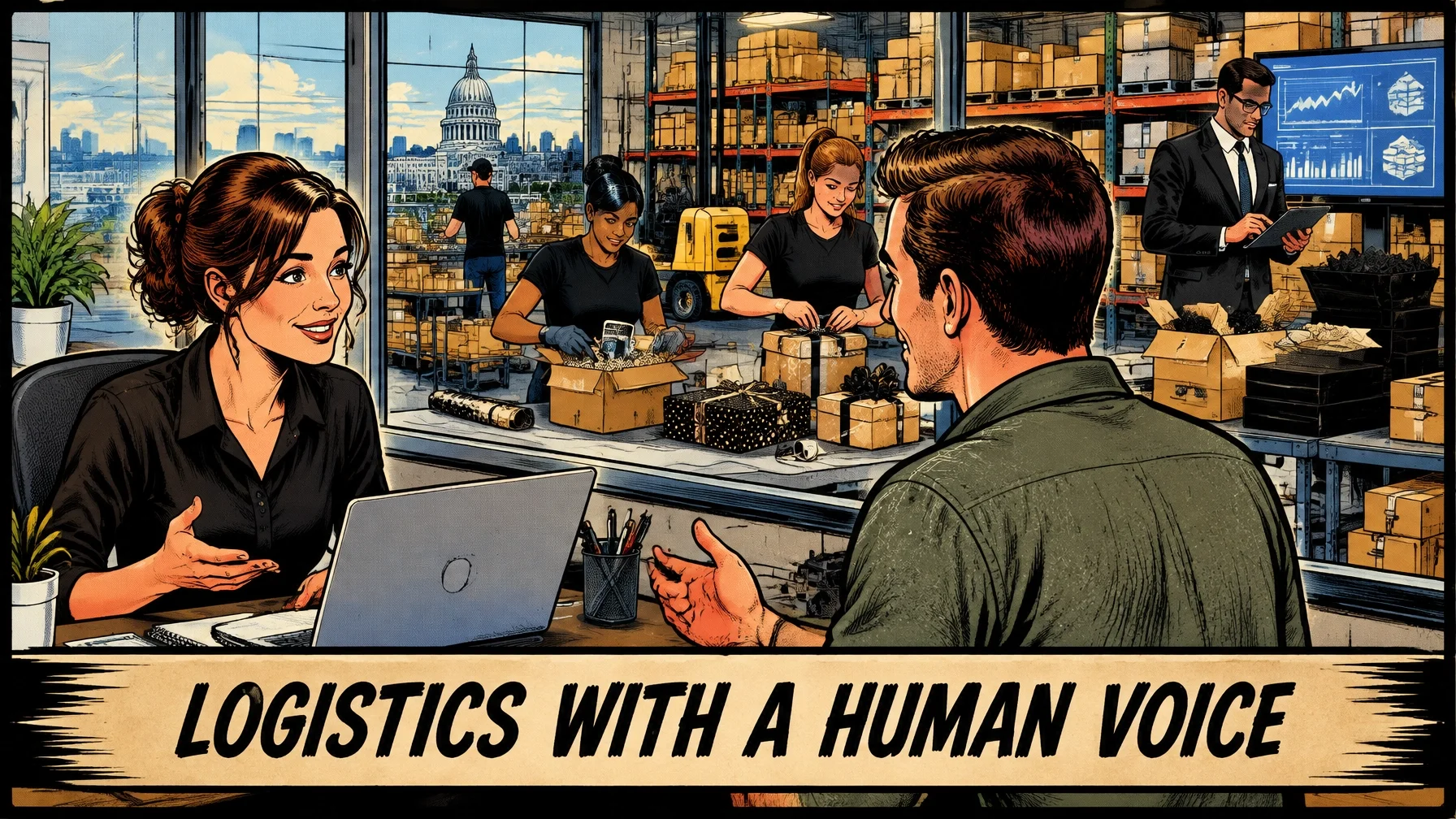
LOGISTICS WITH A HUMAN VOICE!
The Bottom Line
The best fulfillment location is the one that fits your customer geography, product profile, service promise, and growth stage.
For many growing eCommerce brands, the Twin Cities offer a strong middle ground:
Central access to national markets
Competitive ground-shipping potential
Established freight and warehouse infrastructure
Multiple carrier options
A simpler starting point than a distributed network
A Midwest node will not solve every fulfillment challenge. It can, however, give you a more balanced starting position than choosing a warehouse based only on habit or proximity to a founder.
Before you make a move, ask Rogue Fulfillment for a zone and transit review using your actual order data. It is a practical way to see whether a St. Paul fulfillment partner fits your customers, your margins, and your next stage of growth.