
Packaging Costs Are Climbing Again. Right-Sizing Is How You Offset It

Packaging costs are moving higher again.
Industry reporting indicates that containerboard increased for the third time in 2026. September indexes recognized linerboard pricing up approximately $70 per ton and corrugating medium up approximately $100 per ton. Across the latest wave of announced increases, the range was roughly $80 to $140 per ton, depending on the material and supplier.
At the same time, peak-season carrier surcharges are beginning to stack on top of standard shipping costs.
For a growing eCommerce brand shipping hundreds or thousands of parcels each month, that combination creates a familiar problem. You can pressure your 3PL for lower rates, accept smaller margins, or raise prices and risk changing customer behavior.
There is another lever worth examining first: the empty space inside the box.
Why packaging costs may stay elevated
The latest increases are arriving in a market with two competing signals:
Mill capacity has been reduced.
Demand has been softer than expected.
That may seem like a reason prices should fall quickly. However, lower demand does not automatically create abundant supply. When mills cut capacity, there is less room in the system to absorb disruptions, inventory changes, or a later demand improvement.
That is why brands should be cautious about assuming containerboard prices will quickly return to last year’s levels. The index may recognize only part of an announced increase at a given time, and supplier negotiations can affect what you actually pay. Still, the direction is clear enough for planning purposes.
The same box can cost more per unit than it did last year.
Oversized and overpacked products feel the impact most because they use more corrugate, require more void fill, occupy more storage space, and often create higher transportation costs.

Measure the space. Protect the margin.
The hidden cost of extra space
Your carrier does not price a package based only on the value of the product inside it.
Dimensional weight, often called DIM weight, uses package volume to calculate a billable weight. If the dimensional weight is higher than the actual weight, the carrier may charge based on the larger figure.
That means a lightweight product can become expensive to ship simply because it is placed in a larger carton.
A box that is two inches too large may push a parcel into the next DIM tier. Depending on the carrier’s rules, package shape, and service, an oversized carton may also trigger:
Additional-handling charges
Large-package or oversize surcharges
Higher peak-season demand fees
More expensive rate-shopping options
Greater risk of damage caused by movement inside the carton
These charges are based on size thresholds and handling requirements, not on whether the product is valuable, fragile, or easy to pack.
An oversized box during peak season can therefore be hit twice:
The box costs more to purchase.
The parcel costs more to move.
Right-sized packaging is one of the few operational changes that can reduce both costs at the same time.
Peak surcharges make box selection more important
UPS announced peak surcharges beginning September 27, 2026. FedEx announced changes beginning September 28. USPS rate tables are moving in early October, with additional demand surcharges layered later in the season.
These dates and carrier changes are based on supplied industry information. Verify current schedules, service rules, and account-specific terms directly with each carrier before making final decisions. You can also review the UPS demand surcharge information as part of your planning.
The practical point is simple. Peak pricing makes dimensional efficiency more valuable.
If your brand offers free shipping, an increase in package cost and parcel cost can reduce the margin left after every order. If you use a free-shipping threshold, the added expense can change which products and order combinations remain profitable.
Before peak volume arrives, review:
Average package dimensions by SKU
Orders that regularly use large cartons
Products near carrier size thresholds
Shipping costs by zone and service
Free-shipping eligibility
Multi-item orders that create unnecessary volume
Surcharges appearing on recent carrier invoices
This is where multi-carrier fulfillment and rate shopping can help. A smaller package gives your fulfillment operation more qualified carrier options. A larger package may eliminate economical services or create fees regardless of which carrier you select.
Right-sizing does not mean under-protecting products
Protection comes first.
The goal is not to force every product into the smallest possible container. A right-sized package should leave enough room for:
The product
Necessary protective material
Inserts or documentation
Product movement during transit
Multiple items when the order includes more than one SKU
The handling conditions expected for the shipment
A smaller box is not better if it increases damage, replacements, or returns. The right question is not, “How small can we make this package?”
Ask instead, “What is the smallest practical package that protects the product reliably?”
That distinction matters for customer experience as much as cost control. A customer who receives a damaged order does not see the savings from the smaller carton. They see a fulfillment problem.
Five practical steps to right-sized packaging
1. Run a 30-day cube audit
Pull product dimensions, package dimensions, actual weights, shipping charges, and order profiles from the previous 30 days.
For each major SKU and common order combination, identify the box that fits with minimal void fill. Review both single-item and multi-item orders. A product may fit well in one carton alone but create excess space when combined with a refill, accessory, or promotional insert.
Flag packages with more than approximately 15% empty space. Treat this as a practical audit threshold, not a universal rule. Fragile products and unusual shapes may require more room.
Your audit should document:
SKU and product dimensions
Current carton size
Actual and dimensional weight
Void-fill type and quantity
Shipping cost
Damage or return history
Common products purchased together
2. Standardize down
Many eCommerce catalogs can be served by approximately four to six box sizes. Treat that as a useful planning target, not a guarantee.
Fewer sizes can help you:
Reduce packaging cost per unit
Use warehouse storage more efficiently
Speed up packing decisions
Simplify training
Reduce box-selection errors
Make packaging inventory easier to forecast
Standardization does not mean every order receives the same carton. It means your team has a clear, intentional set of options instead of a collection of sizes that accumulated over time.
Create simple packing rules for your highest-volume SKUs and order combinations. Your 3PL should be able to follow those rules consistently and suggest changes when your order mix evolves.
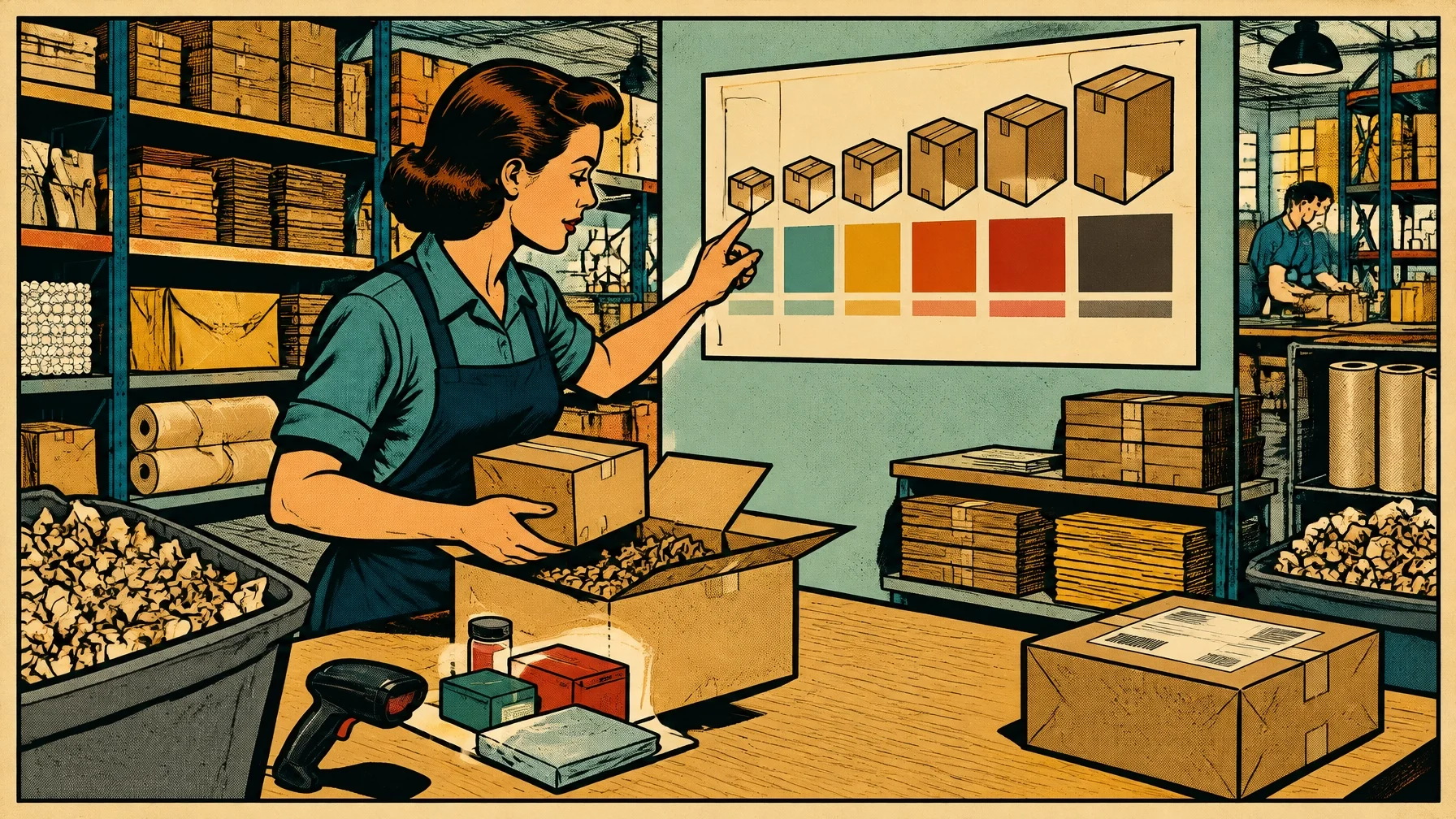
Fewer box sizes. Faster decisions.
3. Check carrier thresholds
Look up each carrier’s current additional-handling and large-package dimensions. Then identify products and packaging formats sitting just over a threshold.
Even a half-inch change can sometimes determine whether a surcharge applies, depending on the carrier’s current rules. Do not rely on old rate cards or general assumptions. Verify the rules directly with UPS, FedEx, USPS, and any regional carriers you use.
Pay particular attention to:
Longest side measurements
Length plus girth
Package weight limits
Non-standard packaging
Irregular shapes
Combined size and weight thresholds
Service-specific restrictions
Measure the finished package, not only the product. Tape, protective corners, inserts, and bulging cartons can change the final dimensions.
4. Right-size the void fill too
A smaller carton does not automatically solve the problem if it is packed with more protective material than necessary.
Choose paper, air, or a properly sized box based on the product and the protection it needs. Avoid paying for all three unnecessarily.
Review whether:
A tighter carton eliminates most void fill
Paper provides enough protection for the product
Air pillows are appropriate for the order profile
A mailer works for non-fragile products
A product-specific insert can prevent movement
Gift wrapping or branded presentation changes the protection requirement
The right answer may vary by SKU. What matters is creating clear, repeatable packing standards.
5. Re-quote packaging now, not in November
Containerboard pricing is moving, so packaging quotes have a limited shelf life.
Compare suppliers before peak season. Ask for updated pricing on your highest-volume carton sizes, mailers, void fill, and custom packaging. Then lock in practical specifications early enough to allow for production, delivery, and warehouse setup.
This is also a good time to confirm:
Board grade and strength
Minimum order quantities
Lead times
Storage requirements
Alternative suppliers
Custom print or packaging design needs
Pricing expiration dates
A packaging change made in September gives your team time to test it. A packaging change made during peak creates more risk.
Automation is the direction of travel, not a requirement
The packaging industry is moving toward on-demand right-sizing.
Packsize offers on-demand corrugated box systems that create cartons around order requirements. Rennco’s 301 Paper E-Commerce System has been presented as a way to right-size paper bags and reduce shipping cost and material waste. Fraunhofer’s CASTN carton-sizing software is being commercialized to reduce empty space ahead of packaging rules in the European Union. BEUMER’s robotpick represents the broader move toward automated bulk parcel handling.
These examples show where the industry is heading. They do not mean every growing brand needs automation immediately.
Most brands can capture substantial benefit by improving box selection, measuring finished packages accurately, and writing clear packing rules. Automation becomes more relevant when order volume, SKU complexity, labor constraints, or package variety justify the investment.
Right-sizing also has a sustainability benefit. Less empty space can mean less void fill, less corrugate, and fewer unnecessary truck miles. The primary objective should still be reliable product protection and sound economics.
Why this matters to a growing eCommerce brand
Packaging changes affect more than the warehouse budget.
A practical right-sizing program can support:
Healthier margins: Lower material and shipping costs leave more room after fulfillment.
Peak-season planning: Smaller packages may reduce exposure to size-based surcharges.
Free-shipping decisions: Better cost data helps you set thresholds based on actual order economics.
Customer experience: A well-fitted package feels more intentional and is easier to open.
Product protection: Clear standards reduce inconsistent packing decisions.
Repeatable operations: Fewer carton choices simplify training and improve warehouse speed.
Multi-carrier fulfillment: Accurate dimensions produce better rate comparisons.
For brands between $2 million and $50 million in revenue, these improvements can become meaningful without requiring a complete technology overhaul.
How Rogue Fulfillment can support the review
Rogue Fulfillment is a boutique 3PL for eCommerce brands based in St. Paul, Minnesota. That supports packaging reviews, custom packaging design, sourcing, kitting, gift wrapping, and other value-added services as part of the operating relationship— rather than treating every need as a separate add-on.
Rogue-stated performance figures include a 99.84% order accuracy rate and 99% of orders shipped within 24 hours. These are company-stated figures, not guarantees. Rogue also provides dedicated account management, same-day inventory processing, and 24/7 access to real-time data.
That combination can make it easier to connect packaging decisions with inventory, fulfillment, shipping, and customer experience. Brands also receive free access to The Rogue Cooperative network, which supports business growth and peer connection.
The bottom line
Containerboard prices have risen again, and peak carrier surcharges are arriving at the same time. Pressuring your 3PL or accepting lower margins may not be the only answer.
Start with the empty space.
Audit your cube, standardize your carton set, check carrier thresholds, review void fill, and re-quote packaging before peak volume arrives. Right-sized packaging will not solve every cost problem, and it should never compromise product protection. But it can reduce material usage and shipping expense with one operational change.
If you want a second look, contact Rogue Fulfillment for a free peak-season packaging and shipping cost review before surcharges bite.