
A Warehouse Tour for People Who Have Never Seen a Warehouse
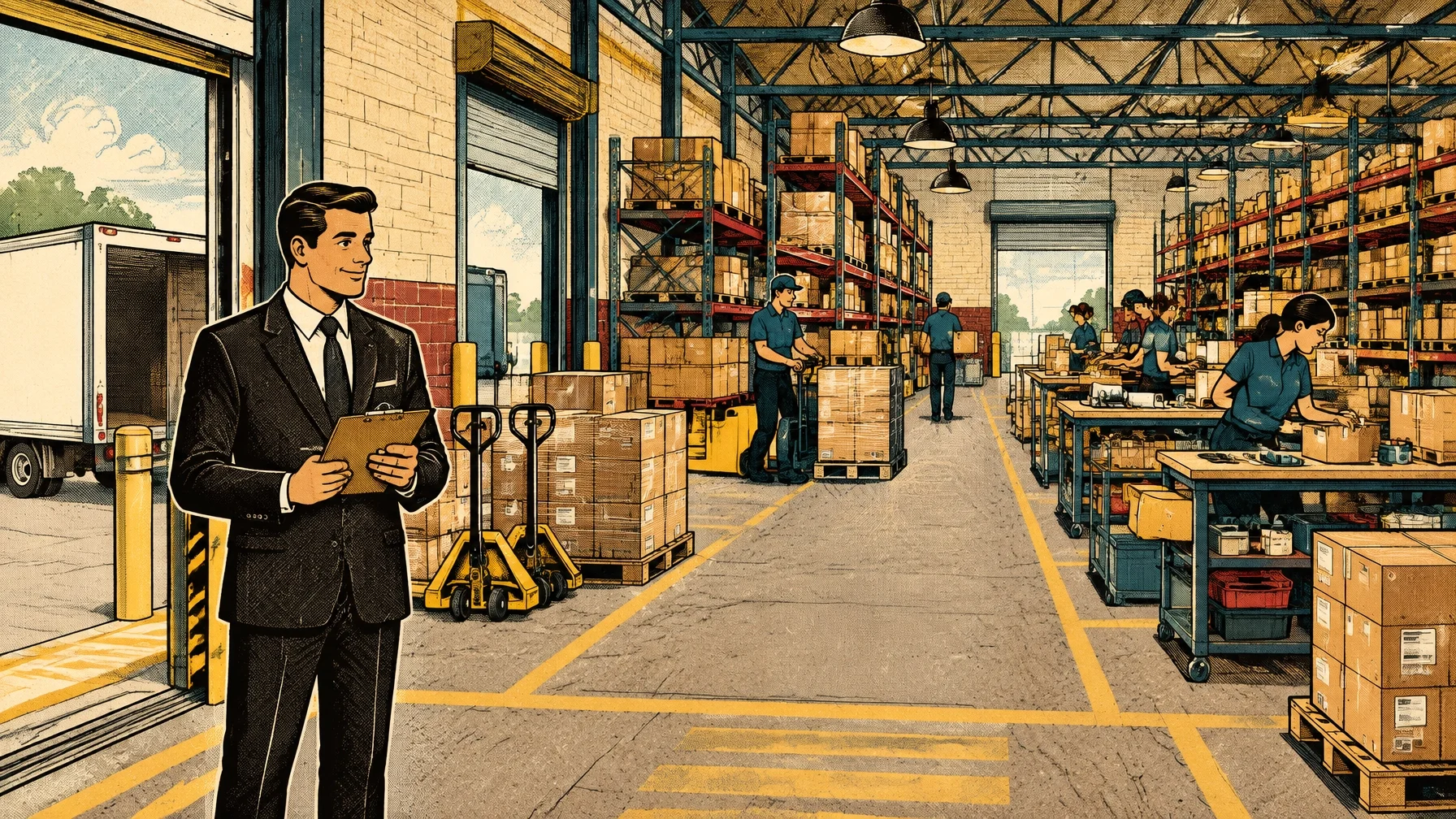
If you have only fulfilled orders from a kitchen table, a warehouse can seem like a different world. Dock doors, storage aisles, barcode scanners, packing benches, shipping lanes, software tracking thousands of products. It looks complicated. The actual path is simple:
Products arrive, get counted, find a home, move into orders, and leave for customers.
Here is what happens at each stage, and why it matters to your brand.
1. Start at the dock and receiving area
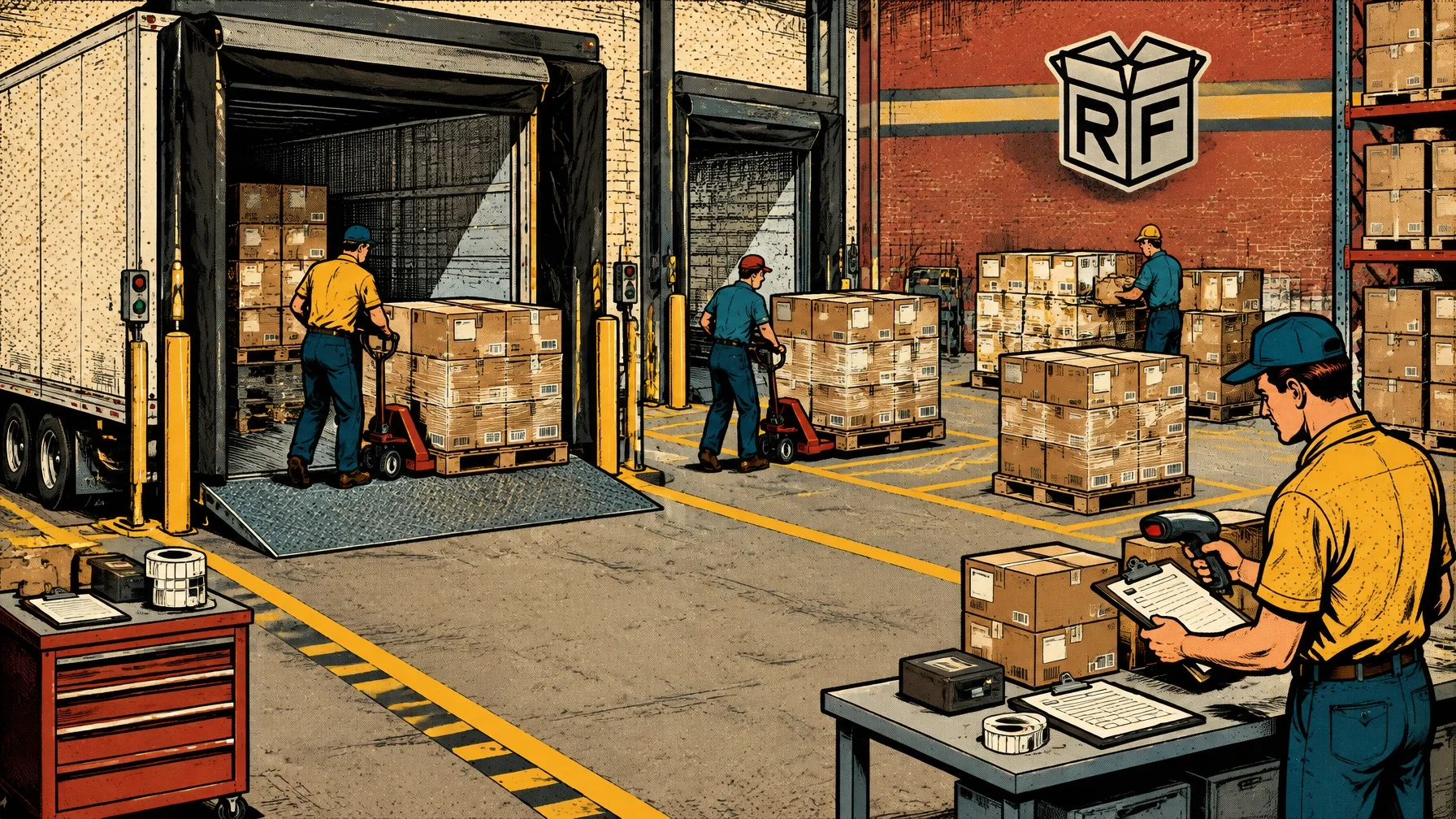
The dock is where inventory enters the building. You may see trailers backed into dock doors, pallets wrapped in stretch film, cartons waiting in staging lanes, and pallet jacks or forklifts moving product inside. A pallet jack is a simple tool for moving pallets across the floor close to the ground.
What happens when inventory arrives?
The receiving team typically:
Unloads cartons, cases, or pallets
Matches the shipment to expected inventory
Counts products and cartons
Checks for visible damage
Reports shortages, overages, or wrong items
Scans products into the inventory system
Stages accepted inventory for putaway
Staging lanes keep incoming product organized while checks are completed. Receiving is your first major accuracy point: if inventory is counted wrong here, that error carries into storage, fulfillment, and customer service.
CHECK IT IN. MOVE IT RIGHT.
2. See how inspection turns into putaway
Once inventory is received, the team decides where it belongs. This step is called putaway: moving products into their assigned storage locations. The team verifies the product or SKU, quantity, condition, storage location, dimensions and weight, and any special handling instructions.
A SKU, or stock keeping unit, is the unique identifier for a specific product or variation. A blue medium shirt has a different SKU from the same shirt in black or large.
Dimensions and weights matter here because they influence packaging selection, shipping rates, dimensional weight charges, and storage planning.
The warehouse management system, or WMS, records where each product lives by linking the product and location through scans. You should be able to see what has been received, what is available, and what still needs attention through your reporting or dashboard.
3. Walk through reserve and forward storage
Most warehouses use more than one type of storage.
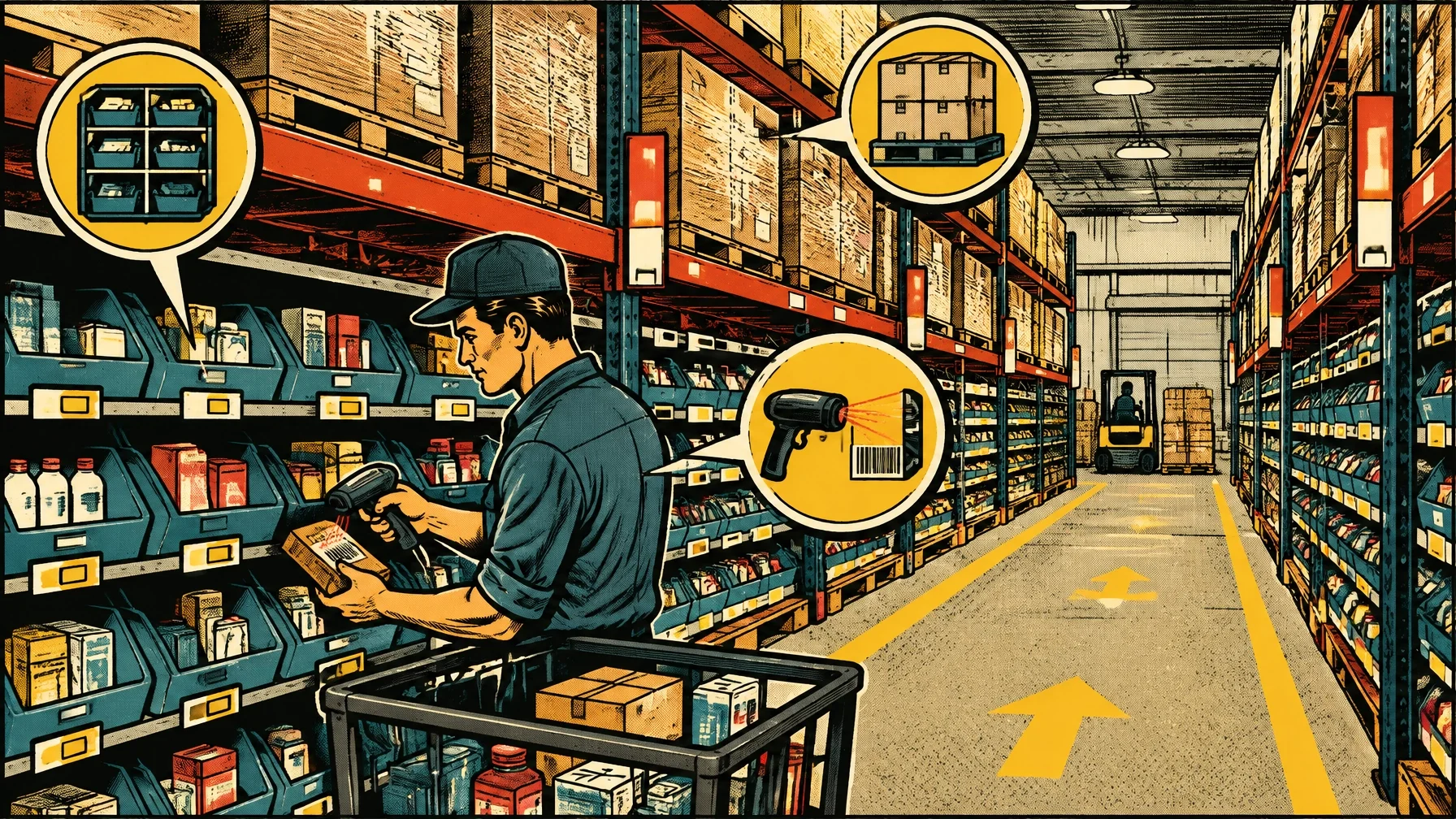
Reserve storage holds larger quantities, usually pallet racking for bulk product or cartons that get replenished into picking locations later. Forward pick storage holds the units workers access most often, in bins, shelves, or pick locations close to the main workflow.
Storage usually includes pallet racks for bulk, shelving for cartons, bins for individual units, and dedicated spots for kits or samples. Your best-sellers live in accessible forward locations. Slow movers stay in reserve.
This arrangement affects labor cost and order speed:
Items stored far from packing create extra walking
Similar items stored too close together invite picking errors
EVERY SKU HAS A HOME.
4. Follow an order through the picking area
Picking is where your inventory becomes a customer order. When a customer buys on Shopify, Amazon, WooCommerce, Etsy, Squarespace, or another channel, the order flows into the fulfillment system and creates work for a picker.
Some operations use paper pick lists, which work for small workflows but rely on manual confirmation. Scan-based picking adds verification: the worker scans the storage location, the product barcode, and the order or tote, and the system confirms the right item and quantity were selected.
Warehouses may also use different picking methods:
Single-order picking: One order is picked from start to finish.
Batch picking: Similar orders are picked together.
Zone picking: Workers focus on one area of the warehouse.
Cart picking: A worker collects several orders on one cart.
The best method depends on order volume, product variety, and order patterns. The pick path is simply the route a worker takes through the building. Good layout cuts unnecessary walking.
5. Stop at the packing stations
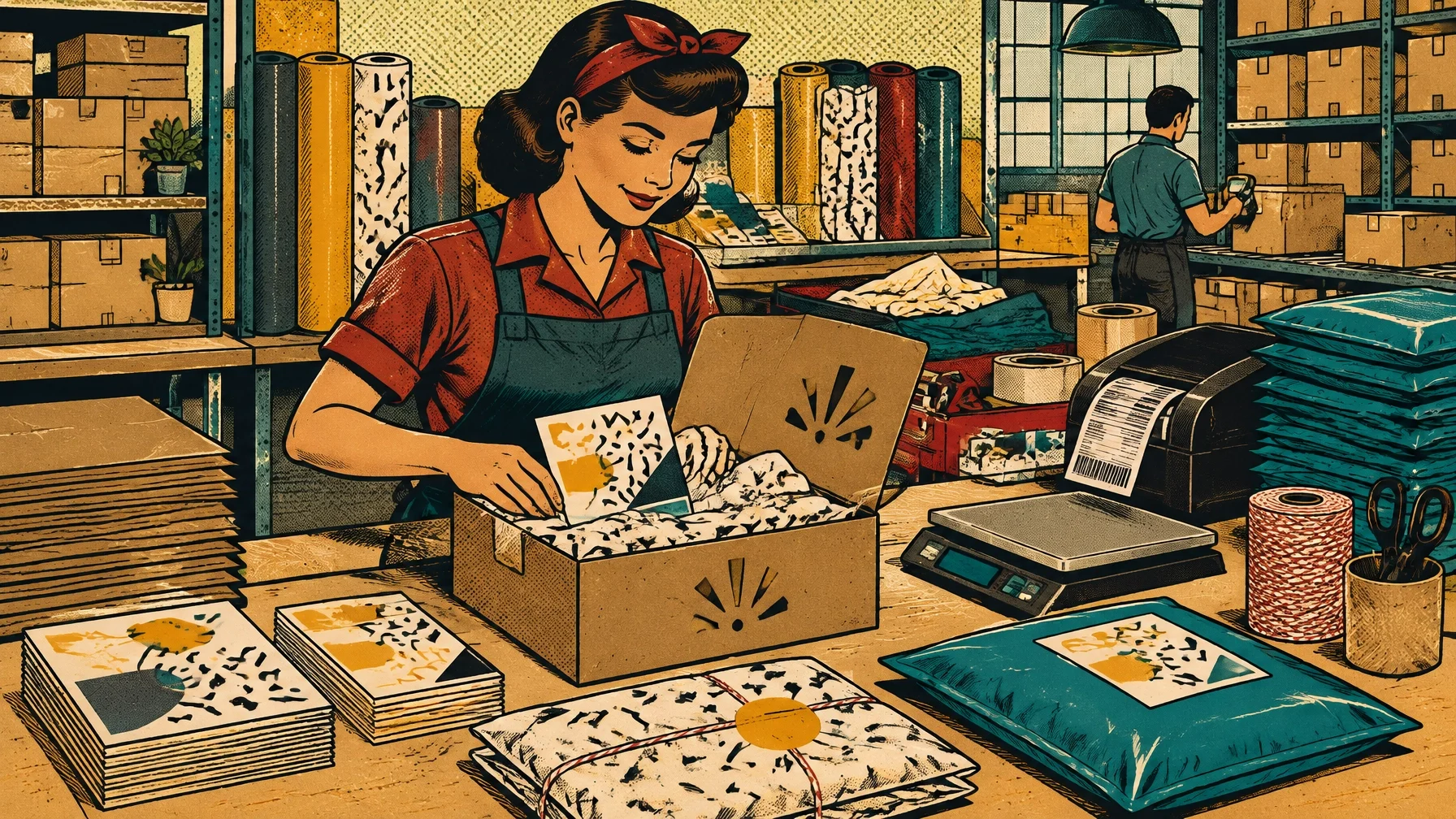
The packing station is where an order becomes a parcel. A typical bench holds boxes and mailers, tape and labels, void fill, a scale, a label printer, scanners, inserts, and gift wrapping supplies. The packer verifies the items, chooses packaging, protects the product, and applies the label.
This is also where your brand experience becomes physical. A station may follow instructions such as:
Use a branded mailer for single-item orders
Add tissue paper or a product insert
Place a sample inside subscription boxes
Use a specific box for a bundle
Gift wrap designated orders
These details belong in the configured fulfillment process, not in old email notes. That is how a 3PL supports personalized unboxing experiences consistently.
PACK IT LIKE YOUR BRAND DEPENDS ON IT.
6. Look at the kitting and value-added area
Some orders need more than one product in a box.
Kitting means combining separate products or components into one finished kit, including labeling and preparing it for sale. Common examples include subscription boxes, product bundles, gift sets, influencer campaign packages, and retail-ready combinations. You may also see supplies for custom packaging design and inserts.
Value-added work is still labor, so it needs a defined process, the right materials, enough time, and clear pricing. Planning it early protects consistency during a launch or campaign.
7. Follow quality control into shipping lanes
Before packages leave the building, final checks may include confirming the order scan, verifying package weight, checking the label and carrier service, reviewing special instructions, and catching visible packaging issues.
Packages then move into shipping lanes, often organized by carrier, service level, destination, or pickup schedule.
Multi-carrier flexibility and rate shopping decide which carrier and service fit a given order, based on weight, dimensions, destination, and cost. Rogue's guide to rate shopping for eCommerce brands explains why that matters.
Cutoff times matter here. If the carrier pickup is at 4 p.m., an order finished after that may not leave until the next business day. Ask for the cutoff times on each carrier and service level.
8. Visit returns, where the process runs in reverse
Returns get their own area because they require different decisions than outbound shipping. A returned product may need to be:
Matched to the original order
Inspected for damage or missing parts
Graded by condition
Cleaned, repackaged, or re-kitted
Restocked, written off, or routed elsewhere
A return is not automatically sellable again. That is why returns processing belongs in its own workflow rather than a pile near the shipping area. Rogue's returns management guidance covers how inspection, grading, and rework recover inventory value.
Underneath all of it, the WMS ties the workflows together through barcode scanning, cycle counting, and order tracking. Cycle counting means checking selected inventory on a regular cadence instead of waiting for one large annual count. Your dashboard should show available inventory, open orders, shipment status, returns status, and inventory adjustments.
What to ask during a warehouse visit or virtual tour
A good tour is a chance to ask practical questions:
How is inventory counted on arrival, and how are errors and damages reported?
How are picking and packing errors tracked?
Who handles my account?
What are the daily order cutoff times?
How is peak-season staffing planned?
How is kitting or campaign work quoted?
Can I access real-time inventory and order data?
What happens when a count does not match the system?
What a warehouse tour tells you, and what it can hide
Clean floors, new racking, and neatly stacked boxes are positive signs. They are not the whole picture. A beautiful warehouse does not automatically tell you whether inventory counts are accurate, how quickly exceptions are resolved, whether communication is consistent, or how your account is supported during peak.
Ask to see the process behind the appearance. How does the team handle the order that will not scan, the shipment that arrives damaged, or the count that does not match? Those moments reveal how the operation really works.
A more personal approach to eCommerce fulfillment
Rogue Fulfillment is based in St. Paul, Minnesota, and works with growing brands that want a 3PL for eCommerce brands with personal attention and brand-level care. That means a dedicated account manager instead of a ticket queue, same-day inventory processing, 24/7 access to real-time data, multi-carrier flexibility with rate shopping, and kitting, gift wrapping, campaign support, and custom packaging design as standard value-added services rather than extras. Clients also get free access to The Rogue Cooperative, a network for business growth and peer support.
Their goal is to help you grow past kitchen-table fulfillment without losing the details that make your brand recognizable.
The bottom line
A warehouse is not just a building full of products. It is a sequence of connected decisions: receive accurately, store intelligently, pick carefully, pack consistently, ship on time, process returns thoughtfully.
When you understand how each area works, evaluating a fulfillment partner gets easier.